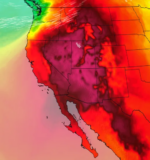

- Records at risk: Dozens of record highs are likely to be set this weekend from California to Montana, and it is possible that a few monthly records could be tied or broken as well.
- Searing highs: Triple-digit heat stretches from Las Vegas to Montana, with cooler pockets in between. Forecast high temperatures Sunday could reach 114 degrees in Phoenix and Las Vegas, and the low-to-mid-90s in downtown Los Angeles. These numbers are down only slightly from Saturday.
- Public health threat: The NWS warns of “major” or “extreme” heat risks across much of the region, indicating a widespread threat to public health from heat exposure. “Major” heat risk is not only centered on the Southwest, but will also stretch from Denver to North Dakota. In Los Angeles, which is under an extreme heat warning, cooling centers are open this weekend through Sunday, though above-average temperatures are forecast to extend into next week. Other major cities like Las Vegas and Phoenix have also opened various cooling stations.
- “Critical” fire danger in Northwest: Elevated fire risk is predicted from eastern Washington southward into Oregon and Nevada, on eastward all the way to the Dakotas. “Critical” fire weather risk — a level 2 out of 3 — is projected for much of Montana and parts of Idaho and Wyoming. In Washington, thousands of residents in Spokane County are under an evacuation order due to the Old Trails Fire.
Extreme heat is the number one weather-related killer in the US each year, according to the National Weather Service. One factor that makes heat so dangerous is when temperatures remain elevated at night, and in Phoenix and Las Vegas in particular, low temperatures will only reach the upper 80s and low 90s. Temperatures this high will rob peoples’ ability to cool down and rest if they don’t have access to cooling, increasing the likelihood of heat-related illness.
What’s the “feels like” temperature forecast near you?
The National Weather Service’s apparent temperature accounts for wind and humidity to forecast what it actually “feels like” outside. See the latest forecast for 5 p.m. Eastern Time each day, starting with the 10 most populous US cities.
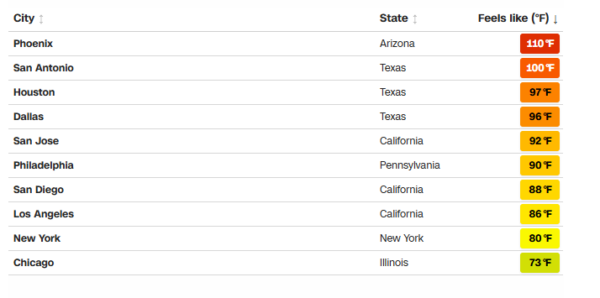
Forecast for Monday, August 3, 2026 | Last updated: August 2, 2026 at 7:38 a.m. ET. Only includes cities in the contiguous US with populations of more than 50,000.
Source: National Weather Service
Graphic: Matt Stiles, CNN
US heat risk forecast
This map shows the forecast risk for heat-related health effects within a 24-hour period for each location in the contiguous United States. Darker shades represent higher risk levels.
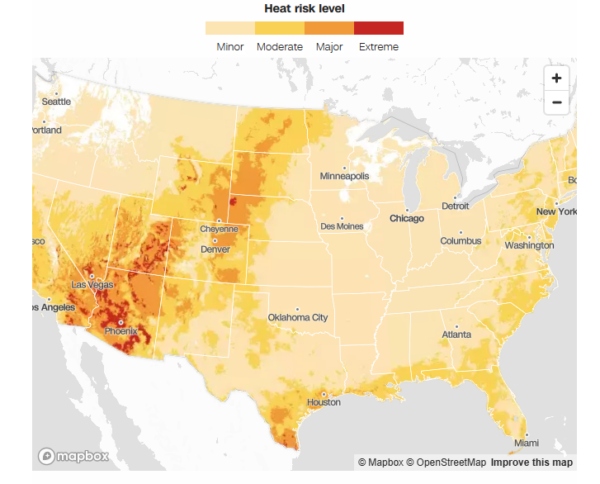
Note: The map shows four risk categories: Minor affects very heat-sensitive people, especially if they’re outdoors without cooling or enough water; Moderate affects sensitive people, could impact some health systems and industries; Major affects anyone without cooling or enough water, likely to impact health systems, industries and infrastructure; and Extreme affects those without cooling or water during prolonged heat with no cool nights, likely to impact most health systems, industries and infrastructure. Areas not shaded represent very low to no risk from heat.
Source: National Weather Service and the US Centers for Disease Control and Prevention
Graphic: Byron Manley, Matt Stiles and Renée Rigdon, CNN
When extreme heat risk is present, it indicates the heat could be deadly, particularly to those without cooling access. Extreme heat risk also means that health systems are likely to see increased demand, including with visits to the emergency room for heat-related illness.
While the heat will be centered on the Southwest for Sunday, some of the most unusual high temperatures compared to average will be found in the Plains and northern Rockies, as triple-digit heat affects Montana, Nebraska, Colorado and Wyoming.
This summer has seen multiple heat domes affect the US and Europe. Human-caused climate change is making heat waves like this one more likely, as well as more intense and longer-lasting, studies show. Particularly strong and slow-moving heat domes are also possibly becoming more common as the world warms, though this is an area of active research.
Fire danger in Pacific Northwest
In addition to the extreme heat, there is continued fire danger for the Pacific Northwest, where the wildfire season in Oregon and Washington is already off to a record pace.
A level 1 of 3 “elevated” fire danger is in place for portions of Washington and Oregon on Sunday. Multiple large wildfires are already burning in this region, and although temperatures have cooled compared to Saturday, gusty winds and low humidity may still pose problems for firefighters.
On Saturday, the National Weather Service had issued a Particularly Dangerous Situation Red Flag Warning across Central and Eastern Washington — a very rare designation reserved for the most extreme fire weather conditions.
Officials had warned of “historically strong winds” and low humidity in the Spokane area, where a fast-moving fire prompted evacuation orders.
On Sunday, air quality alerts are in effect for large portions of Washington and Oregon due to smoke pollution from the wildfires there.


 Photographer Finds Locations Of 1960s Postcards To See How They Look Today, And The Difference Is Unbelievable
  Scientists Discover 512-Year-Old Shark, Which Would Be The Oldest Living Vertebrate On The Planet
  Hus til salg er kun 22 kvadratmeter – men vent til du ser det indvendigt
  Superknepet – så blir snuskiga ugnsformen som ny igen!
  Meteorite That Recently Fell in Somalia Turns Out to Contain Two Minerals Never Before Seen on Earth
 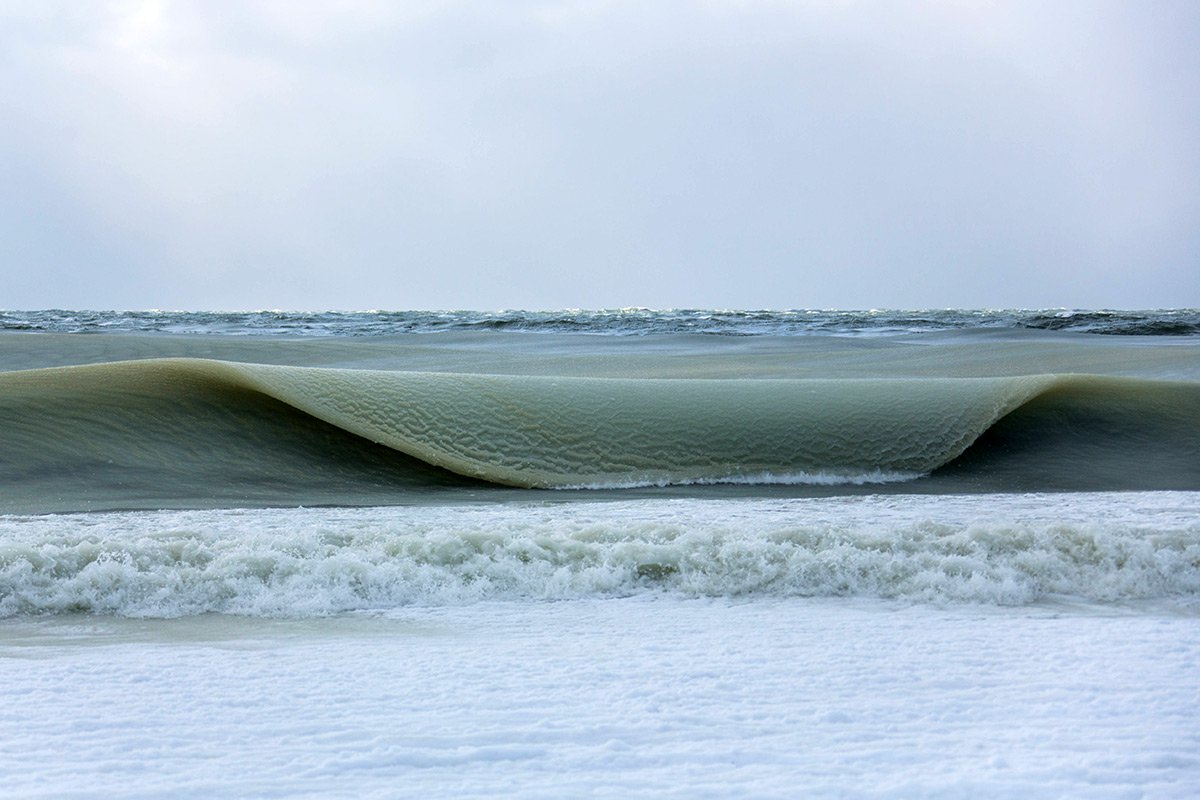 Nearly Frozen Waves Captured On Camera By Nantucket Photographer
 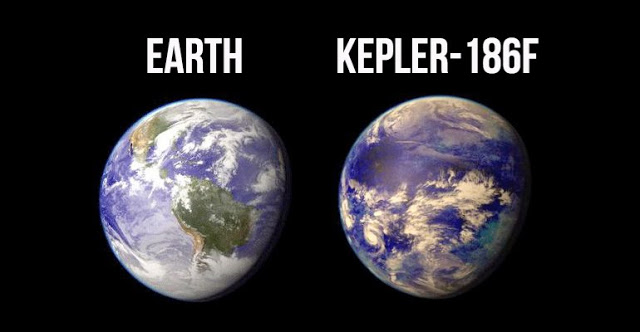 It’s Official: Astronomers Have Discovered another Earth