$64 billion blocked. 71% opposed. The differentiated path exists, but the window to take it is closing.
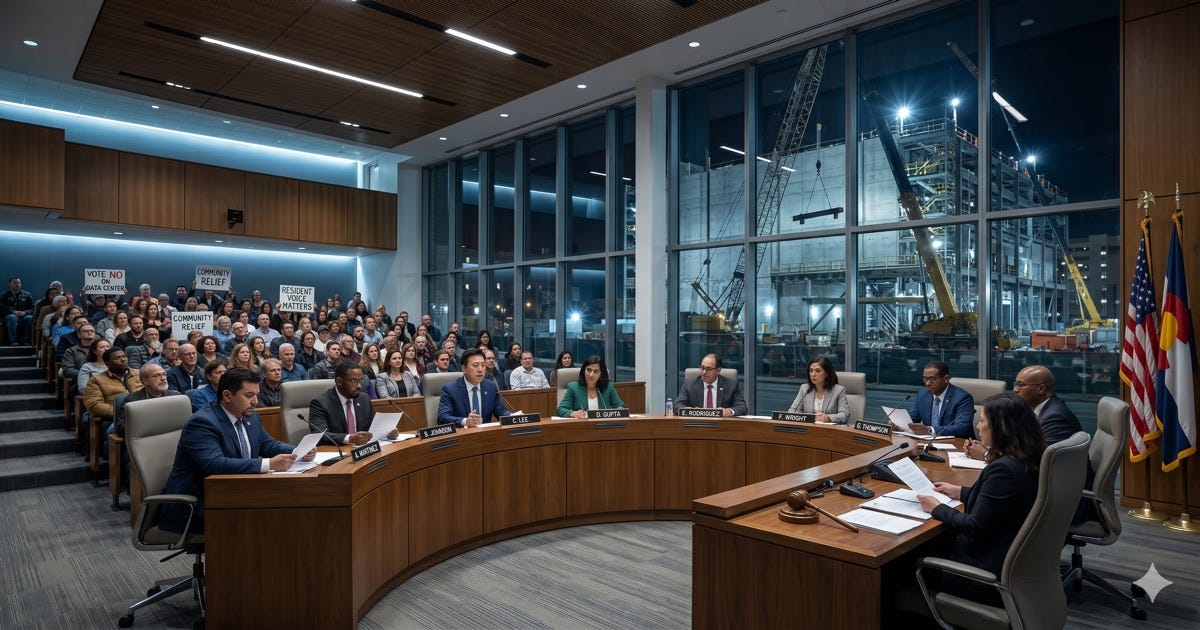
On May 19, 2026, the Denver City Council voted unanimously to impose a one-year moratorium on new data center zoning permits. Not a rural county commission, not a suburb without political infrastructure — the capital of Colorado, acting as one, stopping the industry cold. Council President Amanda Sandoval apologized from the dais for not blocking the CoreSite facility that triggered the vote when the company sought a $9 million tax incentive 18 months earlier. “My biggest regret on council,” she said in public session.²²
Denver wasn’t first. Moratoriums had been spreading through county commissions and small city councils for two years. But Denver marked a category change. It proved the opposition movement had grown sophisticated enough to capture urban governance, where the political power to block, regulate, and shame is considerably greater than in any rural jurisdiction. Seattle followed within weeks — three council members introducing an emergency moratorium after 93,270 constituent emails opposed five
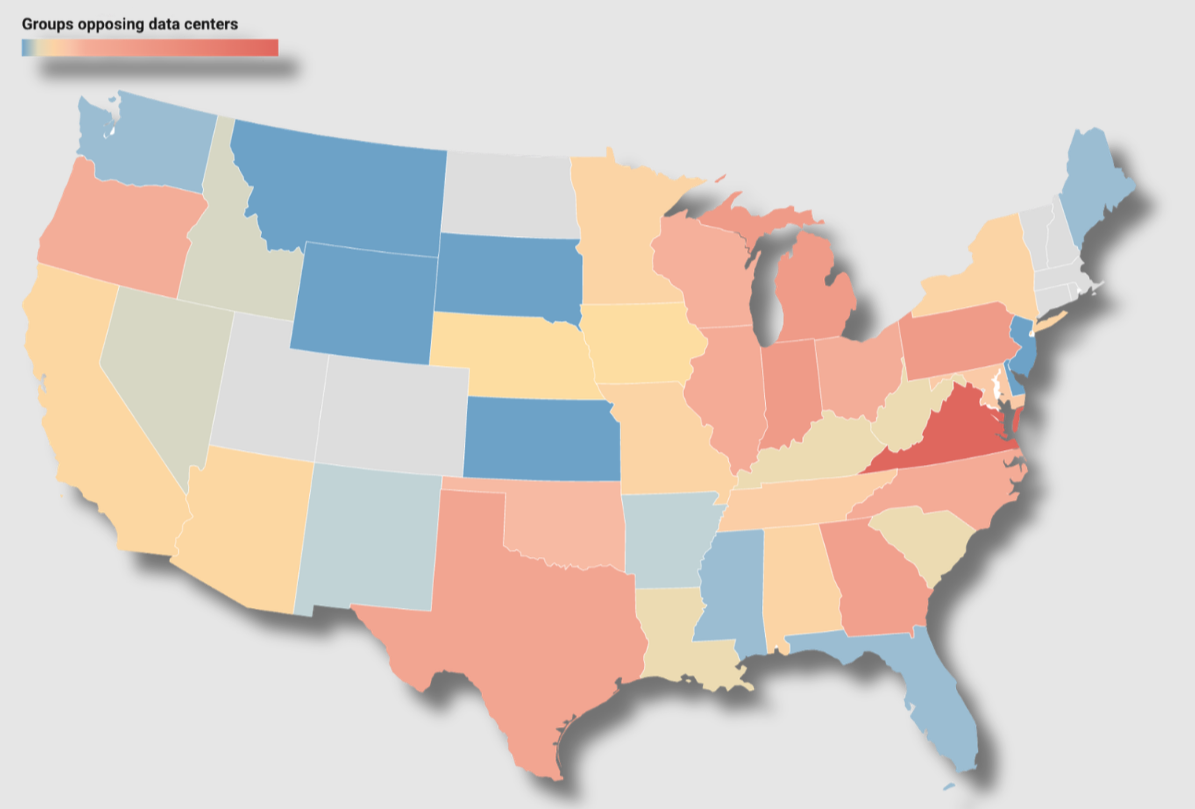
$130 billion in U.S. data center projects were blocked or delayed by community opposition in Q1 2026 alone — a single quarter that roughly matched the total for all of 2025, according to a June 2026 study from Data Center Watch.⁵⁴ Project cancellations quadrupled from 6 in 2024 to 25 in 2025, with 20 more killed in Q1 2026 alone, a record quarterly pace.¹⁷ Active opposition groups more than doubled in a single quarter — from 396 at the end of 2025 to 833 across 49 states by March 2026. “In some cases,” the authors wrote, “opposition mobilized before any project was officially filed — the mere rumor of a data center was enough to trigger organized resistance.”⁵⁴
Against that backdrop, hyperscalers are collectively planning to spend approaching $1 trillion on data center capital expenditure in 2026 — with roughly $150 billion committed to onsite private power generation alone.²⁷ The industry is betting a trillion dollars on a permitting environment that voted unanimously against it in Denver last month.
This article documents that crisis in full — and then makes the case that the crisis is not inevitable. The evidence is clear: developers who adopt proactive community engagement and binding sustainability commitments before opposition forms have materially better permitting trajectories than those who don’t. The differentiated path exists. What the industry does with that information in the next 12-18 months will determine whether it gets regulated differently in every state, or whether it sets its own floor before legislators do it for them.
The Structural Crisis: Five Numbers That Tell the Story

1. Public opinion has inverted
A Gallup poll conducted in March 2026, covering 1,000 adults across all 50 states, found that 71% of Americans oppose an AI data center being built near them — 48% strongly.⁶ Only 27% support new data center siting nearby.
The Virginia numbers are even more instructive because Virginia is the world’s data center capital, and the trajectory is stark. In 2023, 69% of Virginians said they were comfortable with a new data center in their community. By April 2026, that number was 35% — a 34-percentage-point collapse in three years.²⁶ Fifty-seven percent of Virginia residents now believe data centers are negatively impacting their home energy bills. Sixty-seven percent want to end data center sales-tax exemptions — the same population that was 61% supportive of those exemptions in 2023.²⁶
Data centers now rank below nuclear plants in community acceptance.⁶ That is not a communications problem. It is a structural opposition crisis.

2. The tax math has exploded
The political bargain at the center of data center development — tax breaks in exchange for jobs and investment — has collapsed numerically.
Georgia estimated its data center tax breaks would cost $327 million in 2023. The actual cost in fiscal year 2026 is $2.5 billion, a 7.6-fold increase in three years.¹⁶ Virginia’s data center tax exemptions now cost $1.94 billion per year, and the state legislature is considering ending a $1.6 billion annual sales-tax break.⁷ Texas revised its FY2025 projection from $130 million to $1 billion in just 23 months.²⁵ Nationally, experts estimate data center tax incentive costs have reached $90 billion per year, though 14 states fail to disclose these figures at all — in violation of standard accounting requirements.¹⁶

Good Jobs First executive director Greg LeRoy’s assessment: “No form of state spending is more out of control today than data center tax abatements.”¹⁶
The problem for developers isn’t just that the numbers are large. It’s that the jobs promised to justify the breaks haven’t materialized at the scale implied. A typical 100 MW hyperscale campus — representing $500 million or more in capital investment — creates 850 construction jobs over 18 months and then employs 100-200 permanent operations staff.⁷ The Brookings Institution’s analysis of 770 U.S. data center facilities found that “the standard model of data center development has produced mostly short-term construction jobs in recent years and relatively little long-term, high-value tech activity or large-scale employment.”⁷ In colocation counties, tax incentives represent 62% of total investment — the breaks are largest precisely where the employment benefits are smallest.
The rate impact is the other side of this bargain. Our analysis of how large load growth shifts costs onto residential customers found that Virginia’s own legislative auditor projects $444 per year in residential bill increases by 2040 — from a population where 57% already believe data centers are raising their bills.
3. The legislative environment has become hostile
More than 300 state data center bills were filed across 30-plus states in just six weeks in early 2026, shifting from incentive-focused legislation to regulatory oversight.⁴³ Twelve states have active moratorium bills in session.¹⁵ New York’s Responsible Data Center Development Act passed both chambers of the state legislature on June 5, 2026 and now awaits Governor Hochul’s signature — if signed, it will be the first statewide moratorium in U.S. history.⁵ Federal legislation from Sen. Bernie Sanders (I-VT) and Rep. Alexandria Ocasio-Cortez (D-NY) — S.4214 — would impose an immediate federal construction moratorium until Congress addresses energy costs, safety, and worker protections.⁴
Voters in at least five jurisdictions will decide data center ballot measures in 2026.¹⁹ Ohio organizers are pursuing a statewide initiative that would ban data centers above 25 MW.²⁰
4. Water is the issue with the hardest ceiling
Water use is cited in more than 40% of contested data center projects, making it the single most common driver of opposition.¹⁴ U.S. data centers directly consumed 17.4 billion gallons of water in 2023, equivalent to roughly 160,000 American households.² The EPA projects that figure rising to 38-73 billion gallons by 2028.² The largest hyperscale facilities can consume up to 5 million gallons per day on hot days.¹¹
Geographic concentration amplifies the problem. Two-thirds of data centers built or in development since 2022 are located in water-stressed areas — the Colorado River Basin, southern Arizona, Texas.⁴⁰ The Houston Advanced Research Center’s January 2026 analysis projects Texas data center water consumption reaching up to 161 billion gallons annually by 2030, against an aquifer recharge rate in the Trinity system of just 4-5%.⁵²
Hood County, Texas crystallizes what this looks like on the ground. Eight proposed data centers spanning 7,600 acres sit above a recharge zone for the Upper Trinity Aquifer, within the watershed feeding Dinosaur Valley State Park. One project alone would consume 1 million gallons of water per day at full buildout. County commissioners attempted moratoriums twice; both failed after developer lawsuits and state legal warnings. The county has been sued twice by developers for attempting to exercise local control.²⁴
This is not an abstract resource question. For communities that draw water from wells above stressed aquifers, opposition to data center siting is a direct response to a direct physical threat.
5. Noise is the grievance that creates plaintiffs
Data centers emit continuous industrial noise from cooling systems, generators, and fans — 24 hours a day, seven days a week, including during sleeping hours. Monthly backup generator load tests produce 80-100 decibels at the property line, comparable to a leaf blower or motorcycle, running 30 minutes to two hours each.¹² Most county noise ordinances were written to address parties and construction, not permanent 24/7 industrial operations.
In April 2026, residents of the Sacred Heart and Back Central neighborhoods in Lowell, Massachusetts filed the first data center lawsuit in the state, challenging the air permit for an expansion of Markley Group’s 352,000-square-foot facility with 27 diesel generators. The site ranks in the 97th percentile nationally for nitrogen oxide (NOx) exposure and the 90th percentile for adult asthma rates. Yale Law School’s Environmental Justice Law and Advocacy Clinic is representing the plaintiffs.¹⁸
In New Jersey, the first national class-action noise lawsuit targets DataOne USA — a subsidiary of Nebius Group, which signed a $17 billion deal to supply Microsoft AI computing power — for industrial humming that approximately 1,000 residential households within one mile describe as constant and damaging.⁵³
Both cases will produce legal templates that communities across the country will replicate.
The Inflection Point
The Denver and Seattle actions in spring 2026 signal something specific: the opposition movement has crossed a threshold from rural grievance to urban political strategy. Cities have different tools than counties — stronger legislative infrastructure, closer ties to state lawmakers, more media attention, and organized constituent networks. The 93,270 emails that reached Seattle’s city leaders in days represent the kind of constituent mobilization that changes careers.
The implication for site selection is severe. Urban and suburban locations — which typically offer the fiber density, power infrastructure, and low-latency positioning that hyperscalers need — now carry moratorium risk that did not exist six months ago. The JLL 2026 Global Data Center Market Outlook now ranks “community support” as the number two site selection criterion, behind only speed to power.²¹ That placement in the JLL framework — institutional real estate analysis used by the firms deploying capital — is a clear signal that the industry’s financial infrastructure has absorbed what the technical teams haven’t fully priced in.
The strategic question is not whether the opposition will intensify. It will. The question is whether the industry will set its own standards before 300-plus state bills create an incoherent regulatory patchwork, or wait until each state writes its own rules.
The Differentiated Path: Three Pillars
Developers who adopt proactive community engagement and binding sustainability commitments before opposition forms have materially better permitting trajectories than those who don’t. The evidence is concrete, and in the case of water, the technical problem is already solved.
Pillar 1: Water efficiency — the gap is 12x and it’s closed at the frontier
The industry average water usage effectiveness (WUE) for evaporative cooling is 1.8 liters per kilowatt-hour (L/kWh). AWS is operating at 0.15 L/kWh — 12x better, using closed-loop chip-level cooling deployed at commercial scale. Microsoft went further: in August 2024, it deployed a zero-water cooling design that eliminates evaporative cooling entirely and saves 33 million gallons of water per facility per year. The pilot operates in Phoenix, Arizona, ground zero for data center water opposition in a drought-stressed basin. That deployment is the reference point regulators and communities in constrained markets use when evaluating what is operationally feasible.
The technical problem is solved. The industry has not adopted these approaches as the standard. That gap — between what is achievable and what most developers still propose — is precisely what 300-plus state bills are trying to close by force.
Pillar 2: Engagement before opposition forms — the mechanism is transparency, not money
DBT Data President David Tolson described the approach simply: they committed to sharing full project plans with residents before filing anything — not after. In a community that had already rejected five prior data center applications, this produced a complete reversal from active opposition to community support, driven entirely by process transparency.³⁹
Early engagement prevents the next moratorium. Converting hardened opposition — once community groups have organized and a narrative has calcified — is far more expensive and far less reliable.
Pillar 3: Binding commitments over secrecy — and the standards gap
Lancaster, Pennsylvania’s community benefit agreement (CBA) — the most specific data center CBA in the United States by the assessment of Columbia Law’s Climate Law Blog — includes a hard 20,000-gallon-per-day water cap and $20.25 million in binding cash commitments.³² Researchers who study it still consider it a work in progress, because the community received the agreement two days before the council vote.
The EU Climate Neutral Data Centre Pact has 100-plus signatories with binding power usage effectiveness (PUE) and renewable energy targets. The U.S. has no equivalent. That gap is the direct cause of 300-plus bills in 30-plus states. When state legislators cannot point to a credible industry-produced floor, they write their own — and each state writes something different.
Below: five documented case studies of what proactive engagement produces in practice, the complete water efficiency frontier, what CBAs require to create durable community acceptance, and how the EU regulatory model forecasts the U.S. trajectory.




 Photographer Finds Locations Of 1960s Postcards To See How They Look Today, And The Difference Is Unbelievable
 Hij zet 3 IKEA kastjes tegen elkaar aan en maakt dit voor zijn vrouw…Wat een gaaf resultaat!!
 Scientists Discover 512-Year-Old Shark, Which Would Be The Oldest Living Vertebrate On The Planet
 Hus til salg er kun 22 kvadratmeter – men vent til du ser det indvendigt
 Superknepet – så blir snuskiga ugnsformen som ny igen!
 Meteorite That Recently Fell in Somalia Turns Out to Contain Two Minerals Never Before Seen on Earth
 Nearly Frozen Waves Captured On Camera By Nantucket Photographer
 It’s Official: Astronomers Have Discovered another Earth