
Over the past 24 hours, our planet has offered a stark reminder of the immense, dynamic forces continuously at work beneath our feet. A dramatic sequence of earthquakes across vastly different global fault lines has drawn the world’s attention to the restless nature of Earth’s crust. From the destructive shocks in South America to the deep tremors echoing along the Pacific Ring of Fire, this simultaneous activity provides a profound glimpse into the mechanics of our living planet.
Here is a comprehensive breakdown of the global seismic events of the past day and the geological realities behind them:
The Epicenter of Devastation: Venezuela (Magnitude 7.5 and 7.2)
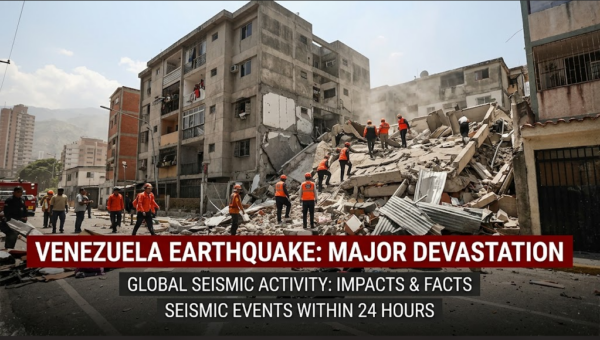
The most tragic and catastrophic events unfolded on June 24th along the northern coast of Venezuela and near its capital, Caracas. Striking just moments apart, two massive earthquakes measuring 7.5 and 7.2 tore through the region. Situated near the complex and volatile boundary between the Caribbean and South American tectonic plates, these massive ruptures resulted in severe devastation.
-
Recent reports confirm at least 188 casualties and over 1,500 injuries.
-
Widespread structural collapse has occurred, with the toll tragically expected to rise as search and rescue operations continue through the debris.
Tremors Across the Pacific: Japan and Papua New Guinea
The Pacific Ring of Fire—the most seismically active zone on Earth—also lived up to its name during this 24-hour window.
-
Japan (Magnitude 6.9): Just hours after the disaster in Venezuela, a powerful 6.9 magnitude earthquake struck off the northern coast near Iwate Prefecture. While the deep tremors were felt as far away as Tokyo, Japan’s world-class seismic infrastructure absorbed the shock; no major damage was reported, and no tsunami warnings were issued.
-
Papua New Guinea (Magnitude 5.4): Continuing the wave of Pacific activity, a 5.4 magnitude quake rattled Papua New Guinea, serving as yet another release of the immense tectonic stress continuously building beneath the ocean floor.
A Historic Shake in California: Mendocino County (Magnitude 5.6)
Positioned near the highly complex boundary where the Pacific and North American plates grind past one another, Northern California experienced a significant geological event of its own. A 5.6 magnitude earthquake struck Mendocino County near Willits. Recorded as the region’s strongest seismic event since 1940, the violent shaking knocked items from shelves, triggered local power outages, and rattled homes, though major structural damage was largely avoided.

The Scientific Perspective: Why Did This Happen All at Once?
When a sequence of dramatic terrestrial events occurs in such rapid succession, it inevitably raises the question: “Are these earthquakes physically connected? Is the planet becoming suddenly unstable?”
The answer lies in the fundamental engine of our planet’s geology: Plate Tectonics.
Earth’s outer shell is not a single, solid piece of rock. It is fractured into a mosaic of massive, shifting lithospheric plates. Driven by the intense heat of the mantle below, these colossal landmasses are in constant motion—grinding, colliding, pulling apart, and sliding past one another. Over decades and centuries, immense stress accumulates along the fault lines where these plates meet. When the friction is finally overcome, the rock abruptly snaps, releasing pent-up energy in the form of seismic waves.
There is no physical domino effect connecting these specific events. While a massive earthquake can sometimes trigger secondary slips on adjacent, already-stressed local faults, the systems in Venezuela, Japan, California, and Papua New Guinea are separated by thousands of miles and sit on entirely independent tectonic boundaries.
The events of the last 24 hours do not signal a global collapse; rather, they are a dramatic coincidence of probability. They are the natural pulse of an active, breathing, and ever-changing world, carrying out its geological cycles in a state of violent, beautiful equilibrium.





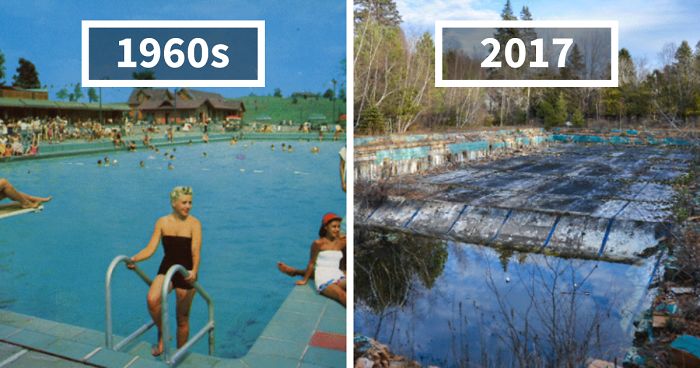 Photographer Finds Locations Of 1960s Postcards To See How They Look Today, And The Difference Is Unbelievable
  Hij zet 3 IKEA kastjes tegen elkaar aan en maakt dit voor zijn vrouw…Wat een gaaf resultaat!!
 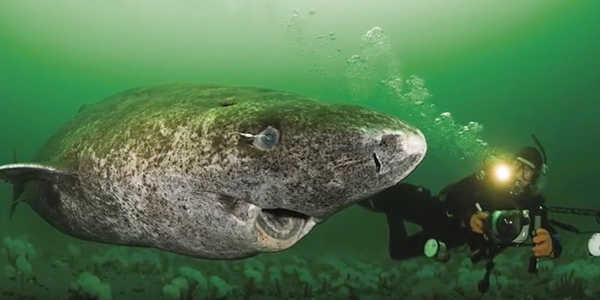 Scientists Discover 512-Year-Old Shark, Which Would Be The Oldest Living Vertebrate On The Planet
  Hus til salg er kun 22 kvadratmeter – men vent til du ser det indvendigt
  Superknepet – så blir snuskiga ugnsformen som ny igen!
  Meteorite That Recently Fell in Somalia Turns Out to Contain Two Minerals Never Before Seen on Earth
  Nearly Frozen Waves Captured On Camera By Nantucket Photographer
  It’s Official: Astronomers Have Discovered another Earth