Massive landslides and flash floods on the Nepal-Tibet border have caused widespread damage and left hundreds dead or missing.
Search and rescue operations are under way. Chinese state media has said there are significant casualties, while Nepalese officials anticipate “huge scale loss”.
Here is what we know so far.
 Nepal Army via EPA
What caused the deadly landslide?
Nepal’s foreign minister initially said an earthquake was reported on the Tibet-Nepal border shortly before the landslide, suggesting it may have triggered the disaster.
The United States Geological Survey (USGS) had first reported the event as a magnitude 4.4 earthquake on Wednesday, but later confirmed the incident “was instead a glacial collapse and debris flow” that “caused subsequent catastrophic impacts downstream”.
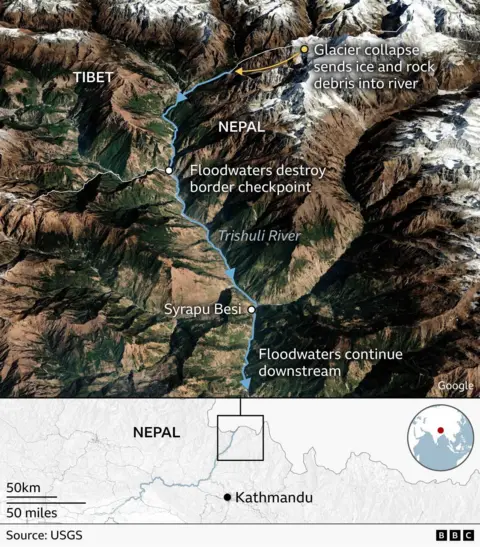
“Additional analysis of nearby seismic stations, long period seismic waves, and satellite imagery led to the determination that the seismic event was instead a glacial collapse and debris flow, and that no earthquake had occurred,” USGS said on Thursday.
Earlier Nepali authorities had also told the BBC that a massive chunk of ice may have collapsed from a mountain, pulling down rocks and other sediments with it.
Climate change is known to be driving faster glacier melt in the Hindu Kush Himalaya region and, as rescue efforts continue, scientists are trying to piece together the exact order of events.
Simon Cook, senior lecturer in energy environment and security at the University of Dundee who specialises in glaciology, said “climate change could have an impact”.
Cook said his team had detected that the lower part of a glacier in Nepal near the Langtang Lirung peak – which is approximately 15km (9 miles) west of the site of the floods – had collapsed.
He estimated that the glacier collapsed in a northwesterly direction and then travelled westwards downstream.


 Photographer Finds Locations Of 1960s Postcards To See How They Look Today, And The Difference Is Unbelievable
  Hij zet 3 IKEA kastjes tegen elkaar aan en maakt dit voor zijn vrouw…Wat een gaaf resultaat!!
  Scientists Discover 512-Year-Old Shark, Which Would Be The Oldest Living Vertebrate On The Planet
  Hus til salg er kun 22 kvadratmeter – men vent til du ser det indvendigt
  Superknepet – så blir snuskiga ugnsformen som ny igen!
 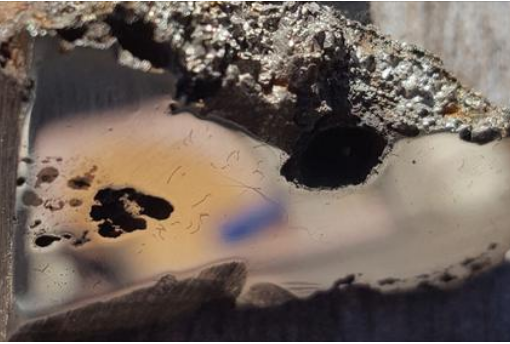 Meteorite That Recently Fell in Somalia Turns Out to Contain Two Minerals Never Before Seen on Earth
 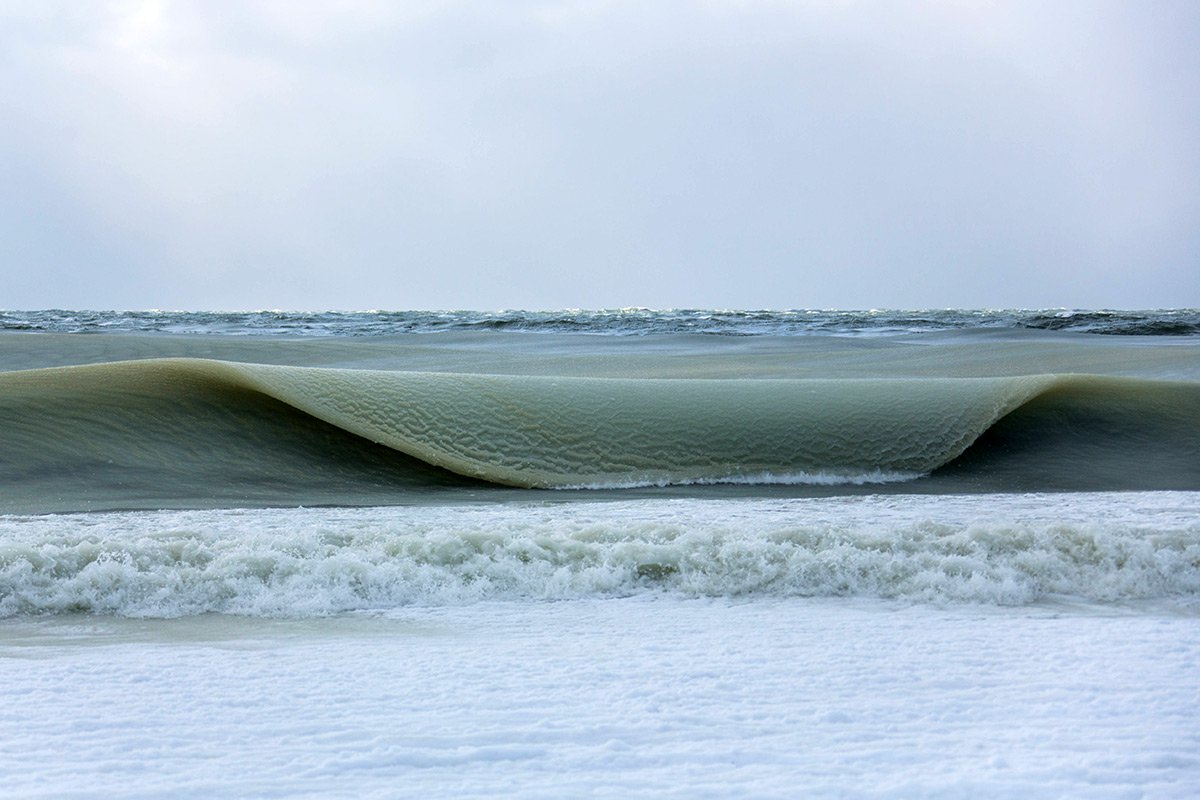 Nearly Frozen Waves Captured On Camera By Nantucket Photographer
 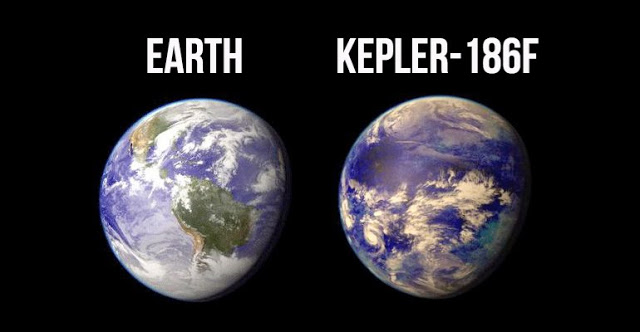 It’s Official: Astronomers Have Discovered another Earth