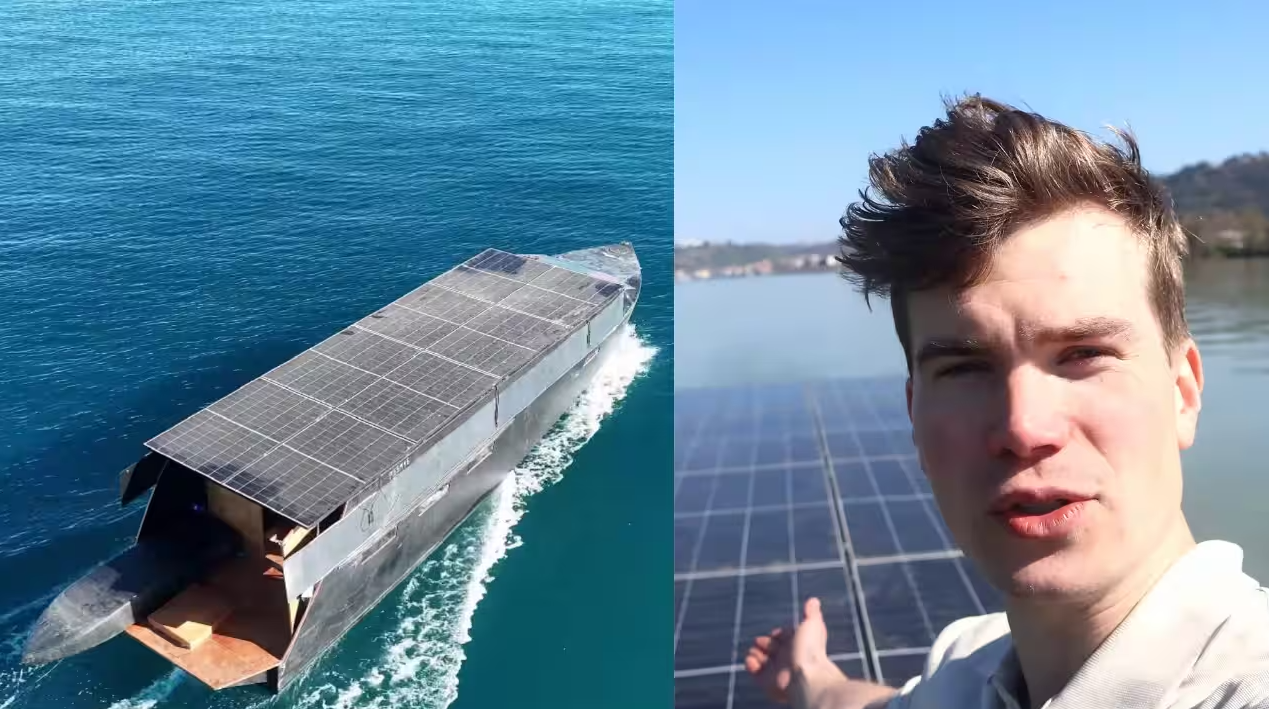
Built by hand and powered by the sun, Helios 11 set off across Europe without conventional fuel.
 © Finnish Sailor Built This Solar Yacht By Hand. Credit: True North
Finnish sailor Lukas Sjöman spent about 200 days building an 11-meter yacht largely by hand. Made from marine plywood and fiberglass, the finished boat weighed about 1.5 tons and carried little more than the equipment needed for life on board.
But the most unusual part of Helios 11 was on its roof. Photovoltaic panels supplied electricity to a battery system that powered the yacht, while an auxiliary sail offered another way to keep moving when the wind cooperated.
Sjöman then took the boat from Finland toward Ibiza, crossing northern and western Europe without relying on conventional fuel. GreenMe reports the journey at about 5,700 kilometers, or roughly 3,540 miles. Another published account gives the distance as 3,106 miles. The figures differ, but the accounts agree that Helios 11 reached Ibiza without refueling.
Helios 11 Runs on Solar Panels and Battery Power
The yacht’s roof-mounted photovoltaic panels can produce about 6 kW of power. Electricity from the array feeds a 48-volt battery system, storing energy for propulsion and equipment on board.
That electricity also has to cover ordinary life at sea. Helios 11 carries an electric stove, a small refrigerator and a toilet.
How much power the panels produce depends on available sunlight and weather conditions. When solar production drops, the yacht can draw on electricity already stored in its batteries.

Weight matters on a boat with a limited supply of energy, which helps explain the lightweight construction. Sjöman also fitted Helios 11 with an auxiliary sail. In suitable wind, the sail can take some of the load off the electric propulsion system and preserve battery power.
The result was a boat equipped to keep moving without stopping for fuel — provided Sjöman could manage the changing conditions along the route.
The Route Crossed Northern and Western Europe
From Finland, Helios 11 traveled through Sweden, Denmark, Germany and France before continuing toward Spain. The route included canals and rivers as well as more exposed stretches of water, putting the yacht through different operating conditions along the way.
Some of the problems had nothing to do with its propulsion system.
At La Rápita, Spain, a utility dinghy used to travel between Helios 11 and shore was stolen while the yacht was anchored. The missing craft was an EZ Raft fitted with a Momentum Electric Marine U2 outboard motor.

Sjöman and his crew did not have a ready-made replacement. They built one instead, using foam and wood to construct an improvised catamaran-style tender that allowed them to continue making trips ashore.
The solar array faced its own scare later in the voyage. Rocks thrown from a bridge struck the panels, forcing Sjöman to check whether the impact had reduced their output.
A comparison with the previous day’s solar production showed no measurable drop in power.
Helios 11 Reaches Ibiza Without Refueling
After passing through several European countries, Helios 11 eventually arrived in Ibiza using electricity generated on board, energy stored in its batteries and assistance from its sail.
The exact length of the voyage remains unclear because published accounts give different totals. GreenMe puts it at about 5,700 kilometers, while another account gives a figure of 3,106 miles.
What did not change between the accounts was the way Sjöman completed the trip. The hand-built electric yacht crossed Europe and reached Ibiza without taking on conventional fuel along the way.




 Photographer Finds Locations Of 1960s Postcards To See How They Look Today, And The Difference Is Unbelievable
  Hij zet 3 IKEA kastjes tegen elkaar aan en maakt dit voor zijn vrouw…Wat een gaaf resultaat!!
  Scientists Discover 512-Year-Old Shark, Which Would Be The Oldest Living Vertebrate On The Planet
  Hus til salg er kun 22 kvadratmeter – men vent til du ser det indvendigt
  Superknepet – så blir snuskiga ugnsformen som ny igen!
  Meteorite That Recently Fell in Somalia Turns Out to Contain Two Minerals Never Before Seen on Earth
  Nearly Frozen Waves Captured On Camera By Nantucket Photographer
  It’s Official: Astronomers Have Discovered another Earth