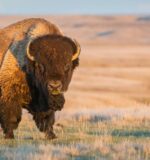

Bison nearly vanished from North America in the late 19th and early 20th century. But conservation efforts in recent decades have seen numbers gradually increase, not least in Yellowstone National Park where a herd of around 5,000 animals now live.
These enormous herbivores travel about 1,000 miles each year as they move back and forth along a 50-mile migration route through the park. But how do large, migrating herds such as those in Yellowstone shape landscapes, and do their effects enhance or degrade ecosystems?
That’s what researchers from Washington and Lee University, the National Park Service and the University of Wyoming wanted to find out. So, they spent six years tracking the animals as they moved through the seasons, using field experiments, satellite imagery and GPS collar data to compare grazed and ungrazed plots.
The results of their study, recently published in the journal Science, suggest that Yellowstone bison are reshaping the park’s ecosystems in a largely positive way – creating a patchwork of habitats, which enhances biodiversity while keeping soils healthy.


How exactly do bison enhance ecosystems?
As the large herbivores concentrate in the river valleys during spring and summer, they feed heavily on new shoots, creating landscapes that appear overgrazed but are in fact the opposite, explains Bill Hamilton, a professor at Washington and Lee University.
“What we’re witnessing is that as bison move across the landscape, they amplify the nutritional quality and capacity of Yellowstone.
“Their grazing likely has important consequences for other herbivores and for the food web as a whole, similar to the changes that occurred in the Serengeti when the wildebeest population recovered.”
By consuming young plants, bison speed up the nitrogen cycle. Soil microbes increase, recycling more nitrogen into forms that plants can use. This results in grasses that grow just as much as ungrazed ones but are 150% more nutritious, explains Hamilton, who says these benefits ripple outward, supporting other animals and enriching the entire food web.
“With the current large herds of bison, Yellowstone grasslands are functioning better than in their absence,” Hamilton says. “And this version is a glimpse of what was lost when bison were nearly wiped out across North America in the late 1800s.”
Jerod Merkle from the University of Wyoming agrees. “The return of a large-scale bison migration provides clear benefits to the ecosystem services that underlie Yellowstone,” he says. “Heterogeneity is what bison seem to provide. When I look out across the bison migration, there is strong variation in the amount of grazing – some places appear to be very short lawns while others remain untouched.”
Unlike fenced or managed populations, Yellowstone’s bison demonstrate that freedom of movement is central to the ecological benefits they bring to landscapes, the study concludes.





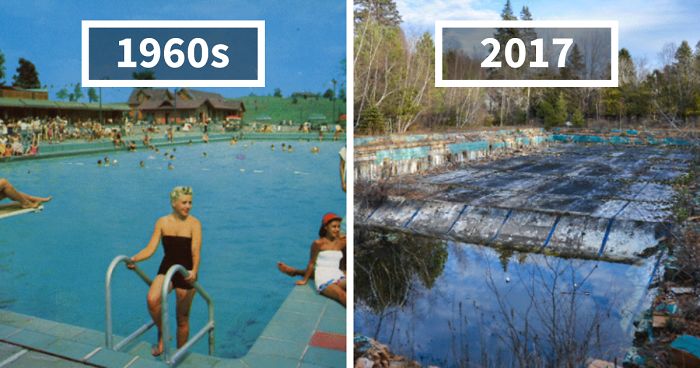 Photographer Finds Locations Of 1960s Postcards To See How They Look Today, And The Difference Is Unbelievable
  Hij zet 3 IKEA kastjes tegen elkaar aan en maakt dit voor zijn vrouw…Wat een gaaf resultaat!!
 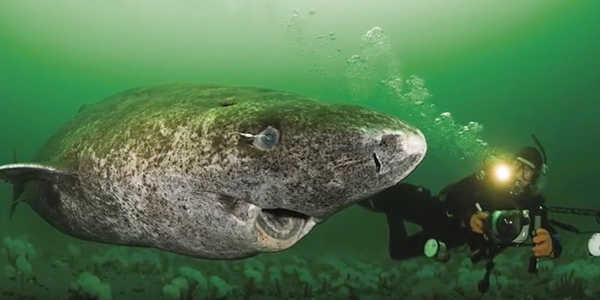 Scientists Discover 512-Year-Old Shark, Which Would Be The Oldest Living Vertebrate On The Planet
  Hus til salg er kun 22 kvadratmeter – men vent til du ser det indvendigt
  Superknepet – så blir snuskiga ugnsformen som ny igen!
  Meteorite That Recently Fell in Somalia Turns Out to Contain Two Minerals Never Before Seen on Earth
  Nearly Frozen Waves Captured On Camera By Nantucket Photographer
  It’s Official: Astronomers Have Discovered another Earth