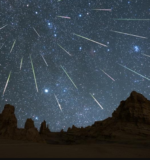

Heads up stargazers! The Taurid meteor shower is upon us, bringing multiple peaks of activity that could see spectacular shooting stars and fireballs brighten November’s sky. Here’s where and when to look.
What is the Taurid meteor shower(s)?
Every autumn, Earth plows through streams of debris left behind by Comet Encke, a 3-mile-wide (4.8-kilometer) ice body that orbits the sun once every 3.3 years.
These debris streams produce two branches of the Taurid meteor shower: The Southern Taurids, active from Sept. 20 to Nov. 20 and the Northern Taurids, active from Oct. 20 to Dec. 10.
As Earth plows through the debris streams, tiny particles slam into our atmosphere at 65,000 miles per hour (104,607 kilometers per hour), producing dazzling streaks of light across the night sky.
Both branches of the Taurid meteor shower appear to travel away from a point of origin — or radiant — located in the constellation Taurus, which rises in the southeastern sky during November evenings.
The Taurids are known for spawning brilliant fireball meteors, which can flare brighter than Venus as pebble-sized pieces of debris enter and burn up in the atmosphere.
When to look for Taurid shooting stars
The Southern Taurid shower features two distinct yearly peaks, the first of which occurred on Oct. 14. The second takes place overnight on Nov. 4-5 and is associated with an increase in fireball activity, when up to five meteors per hour could be seen blazing across the sky.
The Northern Taurid stream, meanwhile, is expected to peak overnight on Nov. 11-12 with the same predicted hourly rate of up to five meteors per hour streaking across the dark, near moonless sky.
How to spot Taurid meteors
Head out to a dark sky location around midnight on the night of the peaks, when the shower’s radiant in the constellation Taurus is positioned high in the southeastern sky, maximizing the number of meteors that can be seen.
Remember not to stare directly at the radiant. Meteors seen close to the constellation Taurus strike our planet almost head-on, and so will have the shortest trails. Instead, pick out a patch of sky a little distance away, where the shooting stars will be at their most eye-catching as they skim through Earth’s atmosphere.

Never use a telescope or binoculars to hunt for meteors, you want to take in as much of the sky as possible, not limit your field of view! And be sure to wrap up warm and allow 20-30 minutes for your eyes to adapt to the dark — a vital and often overlooked step for anyone hoping to catch even the faintest of meteors.
Check out our picks of the best cameras and lenses for astrophotography, along with our guide to capturing fast-moving meteors if you want to create a permanent memory of the next big shower.



 Photographer Finds Locations Of 1960s Postcards To See How They Look Today, And The Difference Is Unbelievable
 Hij zet 3 IKEA kastjes tegen elkaar aan en maakt dit voor zijn vrouw…Wat een gaaf resultaat!!
 Scientists Discover 512-Year-Old Shark, Which Would Be The Oldest Living Vertebrate On The Planet
 Hus til salg er kun 22 kvadratmeter – men vent til du ser det indvendigt
 Superknepet – så blir snuskiga ugnsformen som ny igen!
 Meteorite That Recently Fell in Somalia Turns Out to Contain Two Minerals Never Before Seen on Earth
 Nearly Frozen Waves Captured On Camera By Nantucket Photographer
 It’s Official: Astronomers Have Discovered another Earth