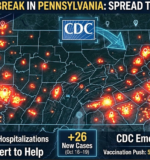

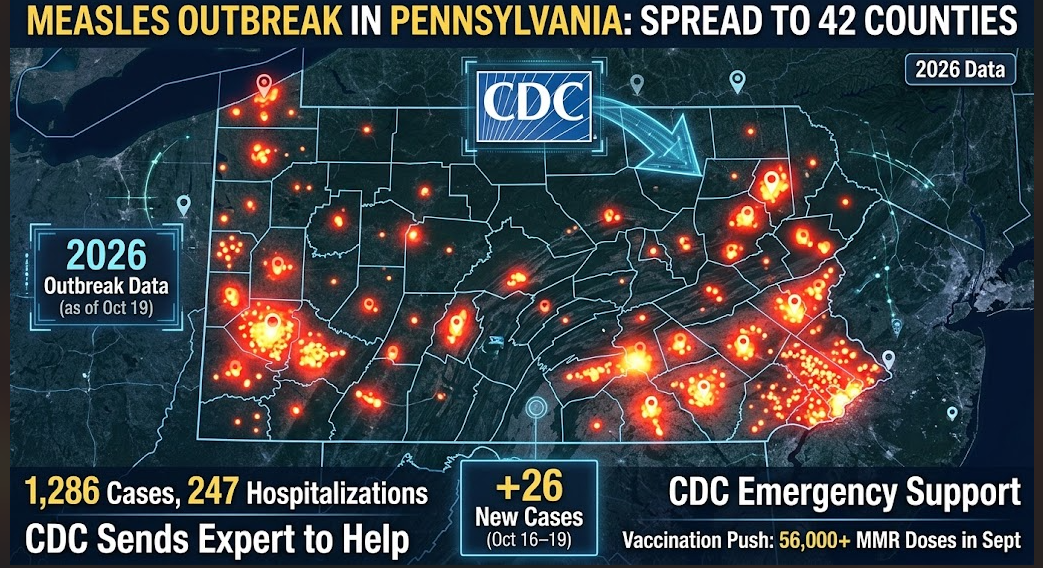
An ongoing measles outbreak in Pennsylvania has quickly become the largest and deadliest in the United States in more than 30 years.
Historical data suggests that 1 to 3 people will die out of every 1,000 unvaccinated people who contract measles. But Pennsylvania has reported five measles-associated deaths — with a sixth under review — out of about 1,300 total reported cases since the start of the outbreak in April.
This puts the measles death rate in Pennsylvania at least 1.5 times higher than average — and possibly up to 5 times higher.
It’s not likely that the measles virus has changed. One factor might be the size of the outbreak and a probable undercount of cases: It’s difficult to know how many people have been affected. It may also be the unique vulnerabilities of the Pennsylvania community where measles is raging.
“There clearly is a shift — not in the biology but a shift in the epidemiology that we’re seeing here in Pennsylvania,” said Dr. Matthew Ferrari, director of the Center for Infectious Disease Dynamics at Penn State University.
Experts say the outbreak is even larger than official data suggests, and it’s not clear how big it is. The US successfully eliminated measles decades ago, making it difficult to estimate how bad the current resurgence has gotten.
A “disease detective” from the US Centers for Disease Control and Prevention arrived in Pennsylvania this week to help better understand the true scale of the outbreak and its trajectory, the state health department said. The scientist, with the CDC’s Epi-Aid program, is also tasked with evaluating the impact of local vaccination efforts.
Scientists and public health workers typically estimate current disease trends by using patterns from recent years, scaling changes against a few variables like birth rates and vaccination rates.
But measles data in the US is quite “outdated,” said Dr. Remy Pasco, a research associate at the University of Colorado Boulder. “It’s not endemic, so we don’t have as much data on it. And because the data has been so scarce, anything we can estimate is with a big grain of salt.”
Pasco has worked on an analysis to estimate the scale of last year’s measles outbreak in Texas. Some underreporting of cases is expected, he says, but it’s unlikely that the rate of underreporting would be the same — even when comparing recent outbreaks in different parts of the US.
There are some “peculiarities” with the outbreak in Pennsylvania, he said. Hospitalization rates with this outbreak are higher than expected. And the Amish and broader Plain community – so named for their simple way of dressing – has a unique way of interacting with the health care system.
Severe outcomes, such as hospitalizations and deaths, are generally the best benchmark for understanding how widespread a measles outbreak is, public health experts say. Not every person who is infected with measles will seek care or testing, but severe cases are more visible in the health care system, and tracking them can help set the ratio to understand the full scale.
A uniquely susceptible group
One signal that this outbreak is different: A disproportionate share of cases are among adults.
About two-thirds of measles cases in Pennsylvania have been among adults, and all but a few were unvaccinated. Nationwide, however, cases skew younger; CDC data shows that more than 60% of cases in the US over the past two years have been among children or teens.
The large population of unvaccinated adults in Pennsylvania, particularly among Amish and other members of the Plain community, has created a uniquely risky outbreak situation, Ferrari said.
Measles complications tend to be more severe for unvaccinated adults than for unvaccinated children, he said. But the low rates of protection among adults in the community also mean vulnerable infants are more likely to be born without protective maternal antibodies.
“We normally think about measles as being a childhood infection,” Ferrari said. “Most people have been exposed to measles or have been vaccinated against measles by the time they reach reproductive age.”
That’s true around the world. Countries typically have high vaccination rates or endemic measles spread, which means people are exposed when they’re younger.
Much of the affected population in Pennsylvania falls into a uniquely susceptible group: both unvaccinated and going decades without exposure because the US had so few cases for so long.
If there’s any explanation for a higher death rate than expected in Pennsylvania, Ferrari said, this would be it: Antibodies — whether from vaccination or infection — aren’t being passed on from women of reproductive age to their babies.
Two infants who were infected with measles have died in Pennsylvania this year, both too young to receive the measles-mumps-rubella (MMR) vaccine.
“Those are absolutely deaths that wouldn’t have been occurring elsewhere in the world,” Ferrari said.
The Pennsylvania Department of Health published an advisory Monday with guidance for measles in pregnancy and congenital measles.
“Due to the ongoing measles outbreak, there is an increase in measles cases during pregnancy, along with rising concerns about congenital measles, which has been identified for the first time in decades,” the advisory said.
Public health knowledge and guidance on this topic continues to develop, the health department said, but a measles infection increases the risk of complications for pregnant mothers and their babies.
‘Boots on the ground epidemiology’
Another complication to understanding this outbreak is an unusually political fight over measles deaths.
Pennsylvania leaders have clashed with federal leaders over measles deaths in Pennsylvania, putting a key data point for understanding the scale of the outbreak into question.
Although the state health department has officially reported five measles-associated deaths, the CDC dashboard includes only three — noting that the “number is subject to change” as additional information becomes available and that the agency is working to “develop a standardized case definition for deaths due to measles.”
In September, the Pennsylvania health department “began the formal process of requesting an Epi-Aid” from the CDC, but Dr. Debra Bogen, the department secretary, noted in a letter to CDC Director Dr. Erica Schwartz that the request would be rescinded “if CDC is unable to transparently and accurately communicate information about those measles-associated deaths.”

Last week, Bogen sent another letter to Schwartz thanking her for the “support and technical assistance from CDC professional staff throughout this outbreak response” and accepting the Epi-Aid as the state health department and CDC staff “continue to collaborate effectively” on measles outbreak response work.
“While the Department is prepared to accept this Epi-Aid, I again ask the CDC to acknowledge the loss of five Pennsylvanians to measles and to report these deaths on the CDC’s public dashboard so that we can repair and rebuild trust in the public health system in the U.S.,” Bogen wrote. “By not acknowledging the deaths, the CDC obscures the seriousness of this disease and the toll of measles across the U.S.”
Without the historical data to use as a benchmark, understanding the true scale of the measles outbreak in Pennsylvania will require investigative public health work.
It’s “classic boots on the ground epidemiology,” Ferrari said, with epidemiologists out and about in the community asking questions about recent health history and vaccination coverage.
“These are outbreaks in populations that haven’t seen this in a long time, and so we can’t rely on the standard approaches that are predicated on consistent or persistent transmission.”



 Photographer Finds Locations Of 1960s Postcards To See How They Look Today, And The Difference Is Unbelievable
 Hij zet 3 IKEA kastjes tegen elkaar aan en maakt dit voor zijn vrouw…Wat een gaaf resultaat!!
 Scientists Discover 512-Year-Old Shark, Which Would Be The Oldest Living Vertebrate On The Planet
 Hus til salg er kun 22 kvadratmeter – men vent til du ser det indvendigt
 Superknepet – så blir snuskiga ugnsformen som ny igen!
 Meteorite That Recently Fell in Somalia Turns Out to Contain Two Minerals Never Before Seen on Earth
 Nearly Frozen Waves Captured On Camera By Nantucket Photographer
 It’s Official: Astronomers Have Discovered another Earth