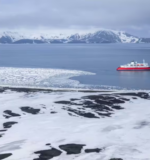
Close to the Antarctic Peninsula lies a tiny and bizarre looking island, Deception Island, whose eastern coast has formed an incredibly straight line.

Close to the Antarctic Peninsula lies a tiny and bizarre looking island whose eastern coast is a straight line. (Image: Getty)
Straight lines are not something we are used to seeing in human nature, as everything has irregularities when viewed up close.
One tiny island near the Antarctic Peninsula, south of the tail of South America, however, has made an impressive attempt at combatting that theory.
Deception Island forms one of the South Shetland Islands and is home to what could very well be the straightest line in nature.
The island is the caldera of an active volcano and has a large and unusually safe natural harbour, which is occasionally affected by the underlying fissure.
The island previously held a whaling station, but it is now mainly a tourist destination, welcoming over 15,000 visitors a year.
Located within the Bransfield Strait, a 60-mile wide and 300-mile-long body of water, the island is roughly circular and horseshoe-shaped.
A huge percentage of the island is covered by glaciers up to 10 metres thick and the centre of the island has been flooded by the sea to form a large bay, now called Port Foster. It has a narrow entrance, just 500 metres wide, called Neptune’s Bellows.
But it is the linear Costa Recta, spanning most of the east coast that usually gains most people’s attention.
The coastline is hypothesised to be a scarp – a steep bank or slope – of a retreated submarine fault.
The first authenticated sighting of Deception Island was by British sealers, William Smith and Edward Bransfield in January 1820 and was first visited and explored by the American sealer Nathaniel Palmer in November that year.
Palmer gave the island its name on account of its outward deceptive appearance as a normal island, when Nepune’s Bellows revealed it instead to be a ring around a flooded caldera.

Deception Island has become a popular tourist stop because of its colonies of chinstrap penguins. (Image: Getty)
The highest peak, Mount Pond on the east of the island, has an elevation of 452 metres.
Deception Island became a focal point of the short-lived fur-sealing industry in the South Shetlands, acting as a convenient rendezvous point for the nearly one hundred ships. However, massive overhunting meant that fur seals neared extinction within a few years and the industry collapsed as quickly as it had started. Deception Island was then abandoned again around 1825.
A second phase of human activity began in the early 20th-century – this time a whaling industry. Soon several hundred men were resident on the island during the Antarctic summers, with as many as 13 ships operating in peak years.
In 1908, the British government formally declared the island to be part of the Falkland Islands Dependencies, thus under British control, and so established postal services and appointed a magistrate and customs officer for the island.
Several structures were built, including a cemetery – the largest in Antarctica, a radio station, a hand-operated railway and a small magistrate’s house.
Scientific stations were built in the 20th-century, but the volcano burst back into life in the late 1960s and destroyed the stations, forcing the island to be abandoned once again.
Today, Deception Island has become a popular tourist stop in Antarctica because of its several colonies of chinstrap penguins, as well as the possibility of making a warm bath by digging into the sands of the beach. Near volcanic areas, the air can be as hot as 40C and water temperature can reach an incredible 70C.
RELATED ARTICLES

October full moon 2026: W...
Your guide to October's full Hunter's Moon, from peak times to skywatching highlights. The full Hunter's Mo

One US measles outbreak i...
Two infants who were infected with measles have died in Pennsylvania this year, both too young to
Orionid meteor shower pea...
The Orionid meteor shower peaks tonight (Oct. 21-22) in the light of a waxing moon. Here's what to expec
Japan built a wall nearly...
After the 2011 disaster, the country built a concrete coastal defense of up to 15 meters high that has already
Bar-tailed godwit flies 1...
The bar-tailed godwit broke the previous world record. (Biosphoto via AFP: André Simon, file pho
TRENDING
-
 Photographer Finds Locations Of 1960s Postcards To See How They Look Today, And The Difference Is Unbelievable
 -
 Hij zet 3 IKEA kastjes tegen elkaar aan en maakt dit voor zijn vrouw…Wat een gaaf resultaat!!
 -
 Scientists Discover 512-Year-Old Shark, Which Would Be The Oldest Living Vertebrate On The Planet
 -
 Hus til salg er kun 22 kvadratmeter – men vent til du ser det indvendigt
 -
 Superknepet – så blir snuskiga ugnsformen som ny igen!
 -
 Meteorite That Recently Fell in Somalia Turns Out to Contain Two Minerals Never Before Seen on Earth
 -
 Nearly Frozen Waves Captured On Camera By Nantucket Photographer
 -
 It’s Official: Astronomers Have Discovered another Earth